
Actuators & drives for channel penstocks
The choice of the appropriate actuation system depends on the size of the channel penstock, the required operating forces, and the desired degree of automation of the system. Depending on the application, solutions range from simple manual operation to fully automatic electric drives.
Since channel penstocks are used in open channels, operation is generally performed via a crossbar. This absorbs the operating forces and enables safe power transmission to the penstock plate.
Our actuations at a glance
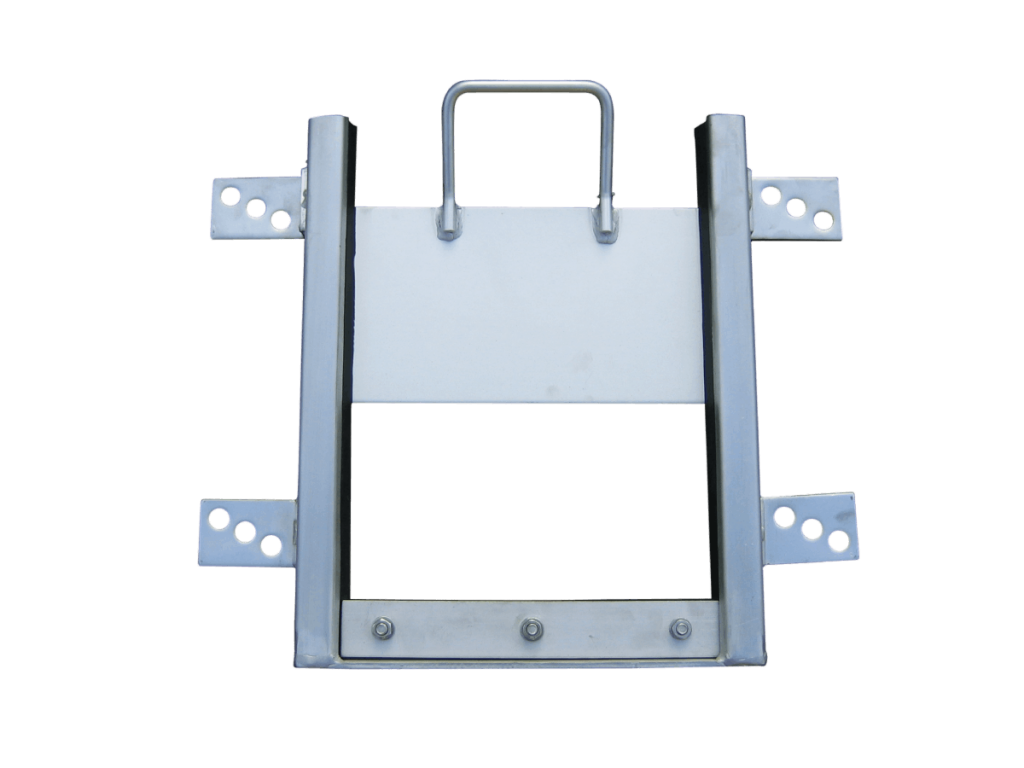
Hand pull
The simplest form of actuation is used for slide gates. The penstock plate is moved directly via a handle. This design is particularly suitable for smaller channels and simple shut-off tasks.
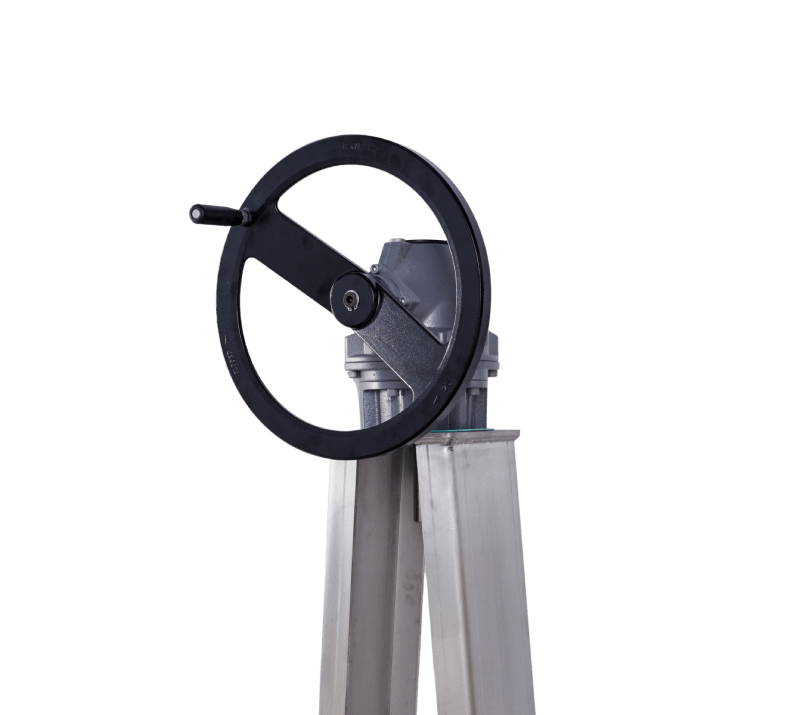
Bevel gear
For larger penstock plates or higher water pressure loads, the required operating forces can increase significantly. In these cases, a bevel gear is used, which reduces the operating forces and allows for comfortable operation.
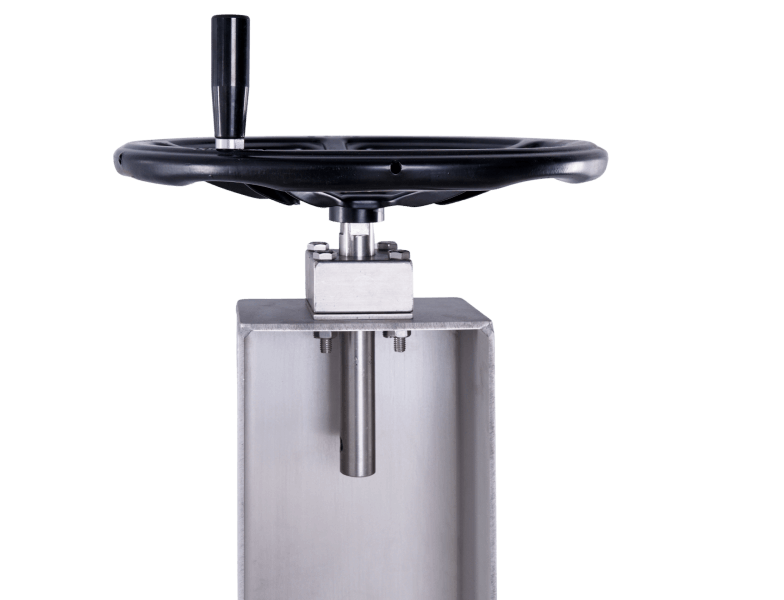
Handwheel
In classic channel penstocks, operation is often performed via a handwheel. This solution is suitable for small to medium-sized penstocks and applications with moderate operating forces.
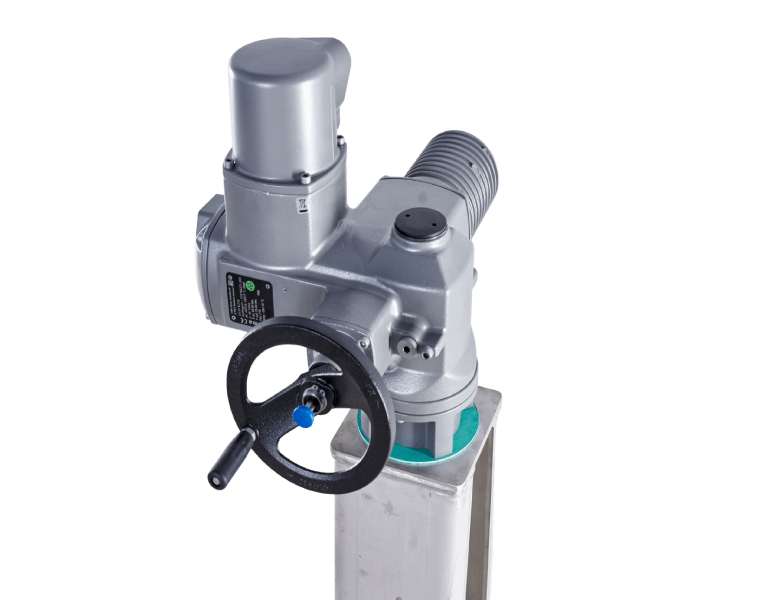
Electric drive
For automated systems, channel penstocks with electric drives are available. This version is particularly suitable for sewage treatment plants, rainwater overflow basins, pumping stations, and other water engineering facilities with remote control or process control technology.
Depending on the requirements, electric drives can be equipped with a local control station, position feedback, limit switches, and further automation functions. Connection to existing PLC, remote control, and process control systems is also easily possible.
Electric drives are used in particular where channel penstocks are operated regularly, large operating forces occur, or operation is to be carried out from the control room.
Rising and non-rising stem
By default, channel penstocks are designed with a non-rising stem. In this design, the stem is located above the penstock and rotates in a bearing firmly connected to the crossbar. The penstock plate is moved up or down along the rotating stem via a stem nut. This design is compact, robust, and represents by far the most common solution in practice.
Alternatively, versions with a rising stem are possible. Here, the stem is firmly connected to the penstock plate. The trapezoidal thread is located in the actuator or gearbox. By rotating the thread, the stem is pulled upwards or lowered together with the penstock plate.
The extending stem is guided in a protective tube arranged above it. TESACO generally uses transparent protective tubes made of Plexiglass for this purpose. This allows the current position of the penstock to be directly visible at all times and can be checked without an additional position indicator.
Double-stem designs for large penstocks
Double-stem designs are used for large and particularly wide channel penstocks. The second stem ensures uniform force transmission to the penstock plate and prevents tilting in cases of large channel widths.
For synchronization, the two stems are connected to each other via additional bevel gears and a cardan shaft. Operation is carried out either via a handwheel, a bevel gear with a handwheel, or an electric drive. The applied driving force is distributed evenly across both stems via the system.
This allows even large penstock plates to be moved safely, evenly, and reliably.
Do you have any questions about the right type of operation?
We would be happy to assist you in selecting the appropriate operation for your channel penstock or large penstock. Based on just a few technical key data points, we can work out the suitable solution for your installation situation.
Upon request, we can provide support in selecting handwheel, gearbox, or electric actuators, as well as answer questions regarding operating forces, automation, and installation scenarios.
Technical clarifications, installation drawings, and quotes are generally provided on the same working day.

Your contacts: Hasan Catalano & David Jung
- +49 (0) 64 30 – 61 10 30
- Mail: info@tesaco.de