
Installation types for TESACO channel penstocks
Depending on the structure and installation situation, channel penstocks can be cast into concrete, bolted into the channel, or mounted in front of the channel. The choice of installation type influences the clear opening, accessibility, and installation effort, among other factors.
Below you will find the common installation types for channel penstocks and large penstocks.
The installation types in detail
A. Casting in concrete in the channel
- For concrete installation, the frame of the channel penstock is inserted into a prepared recess and then grouted.
- The major advantage of this design is that the full clear opening of the channel is maintained and flush integration into the structure is possible. The frame is fully integrated into the structure and does not protrude into the flow cross-section.
- This design is frequently used in new buildings or major renovations.
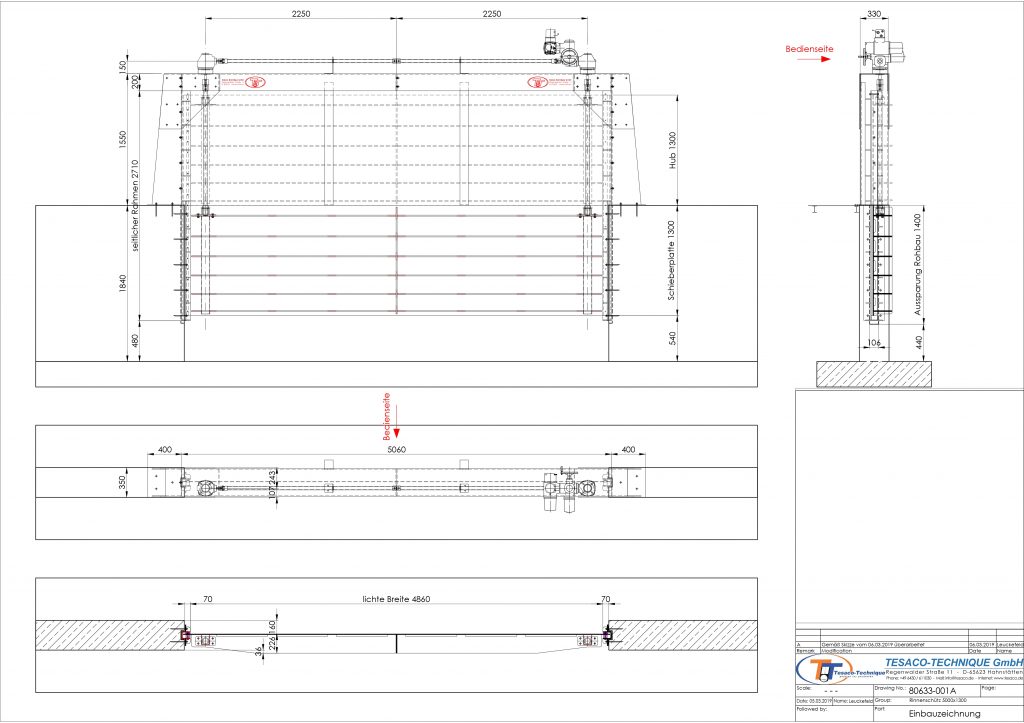
B. Bolting in the channel
- When bolting in the channel, the frame is mounted directly between the existing channel sides.
- Since the frame is located within the channel cross-section, the clear opening is reduced according to the frame dimensions. At the same time, this variant is often the most economical solution for retrofitting existing structures.
- This design is particularly suitable for existing structures where no grouting work is planned or where a penstock is to be installed subsequently.
C. Bolting in front of the channel
- When bolting in front of the channel, the channel penstock is mounted onto the front wall of the structure.
- The full clear opening of the channel is maintained because the frame is located entirely outside the channel cross-section. At the same time, the valve is particularly accessible and maintenance work can be carried out easily.
- This installation type is frequently used when the penstock serves as a closing element at the beginning or end of a channel section.
Invert configuration
- Depending on the structure and installation type, the bottom seal can be integrated flush into the channel invert. This is typically done with cast-in-concrete designs or when corresponding recesses are provided during bolting.
- If flush integration is not possible, the penstock is placed onto the existing channel invert. This creates a threshold of approximately 50 mm in the area of the bottom seal, which should be taken into account during planning.
Do you have questions about the installation type?
We would be happy to support you in choosing the appropriate installation type for your structure. Based on a sketch, a structural drawing, or just a few technical parameters, we can assess which design is suitable for your installation situation.
Upon request, we can prepare project-specific installation drawings and provide support in selecting the appropriate actuator as well as with constructive details such as clear opening, invert configuration, and space requirements.
You will generally receive technical clarifications, installation drawings, and quotes on the same working day.

Your contacts: Hasan Catalano & David Jung
- +49 (0) 64 30 – 61 10 30
- Mail: info@tesaco.de