
Actuations and drive systems for penstocks
Overview of actuation types
- The appropriate actuation depends on factors such as structure depth, operating force, and accessibility. We are happy to support you with your selection. Alternatively, you can also compile the most important project data directly via our penstock configurator.
Actuations in detail
Manual actuation with key
- Manual actuation with key is the standard solution for the majority of all penstocks. It is particularly suitable for installation situations where the penstock is located under a manhole cover, a surface box, or a traffic area, and no fixed actuation should be visible above the structure.
- The actuation is performed via a wall bracket with a square nut. Depending on the design, an operating key or a ratchet wrench is attached to this square.
- As a rule, the wall bracket is located in the upper area of the structure and is operated from above with an operating key. This allows the penstock to be operated comfortably from the ground level without having to enter the structure.
- If the actuation is to take place via a surface box, for example on roads, parking lots, or factory premises, the square is guided to the surface box via a special extension.
- If it is not possible to arrange the wall bracket in the upper structure area or if the penstock is only operated infrequently, the wall bracket can also be arranged directly above the penstock. Operation is then carried out by means of a ratchet wrench within the manhole. In many cases, this eliminates the need for rods, core holes, and surface boxes.
Electric actuator
- Electric actuators are the ideal solution for automated systems and for connection to remote control and monitoring systems. They can generally be used for all penstock sizes and allow operation directly via the system control without manual intervention on site.
- Underground: Suitable if no operating device should be visible above the structure. This version is frequently used on roads, parking lots, factory premises, or other traffic areas.
- Above ground: Ideal if direct access to the drive is desired. Mounting is performed via an actuator stand either on the ceiling or on the wall.
- Usually, the electric actuator is controlled via the on-site PLC or the monitoring system. Upon request, the actuators can also be equipped with a local control station. This allows penstocks to be opened, closed, and the current position to be checked directly on site.
- Depending on the requirement, various position feedbacks as well as communication interfaces for integration into PLC, remote control, and monitoring systems are available. Explosion-proof designs for hazardous areas are also possible.
- The required positioning time is designed project-specifically. Depending on the application, penstocks can be moved particularly quickly or deliberately more slowly. The positioning time results from the combination of drive speed, gearbox ratio, and spindle pitch. Especially in the case of accidents and emergency shut-offs or automated process sequences, we support you in designing the required closing time and select the appropriate drive accordingly.
- For operation during power failure, the actuators can additionally be equipped with a manual emergency override. This ensures that the penstock remains operable even in the event of a power supply failure. The manual emergency override is carried out as standard via a handwheel. Alternatively, a version with a square for an on-site penstock turning tool is also possible.
- In the case of longer delivery times for electric actuators, penstocks and mechanical components can be delivered in advance upon request. The electric actuator is then retrofitted.
Handwheel
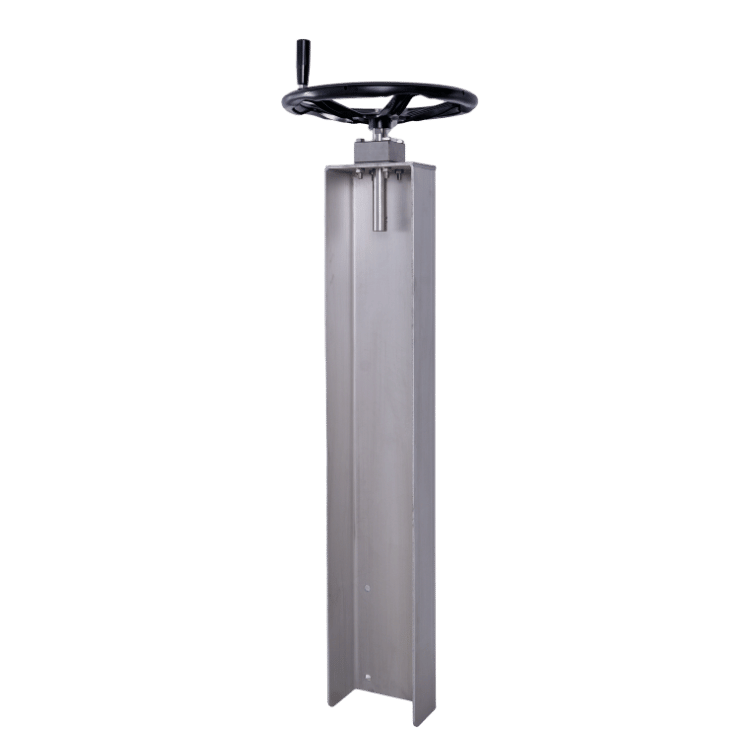
- Handwheel drives are suitable for applications with more frequent operating processes or increased operating forces. In contrast to actuation with a key, the operating level is permanently located above the structure and is directly accessible at all times.
- The actuation is performed via an actuator stand with a handwheel. Depending on the installation situation, this can be mounted on the structure ceiling or on the structure wall. Frequently, the actuator stand is arranged at the edge of the basin or manhole so that the handwheel can be comfortably reached from a walkway or behind a railing.
- Upon request, a version with a tab for an on-site padlock is also possible.
- Handwheel drives are used in particular where penstocks are regularly operated or checked and direct access to the actuation is desired.
Handwheel with gearbox
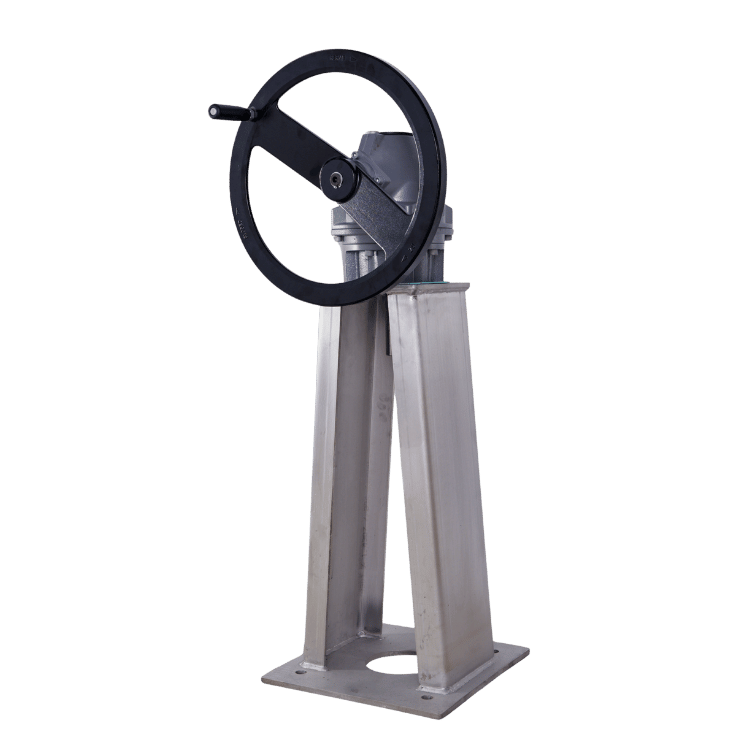
- Handwheel drives with gearbox are used when higher operating forces occur or large penstocks are to be operated manually on a regular basis. Due to the gear reduction, significantly higher forces can be transmitted than with a direct handwheel drive.
- The actuation is performed via an actuator stand or a wall bracket with a bevel gearbox and handwheel. Depending on the installation situation, mounting can be performed on the structure ceiling or on the structure wall.
- Due to the gear reduction and the larger handwheels, even large penstocks with high pressure loads can be operated manually in an economical and comfortable manner. As a result, almost all penstock sizes can be operated without an electric actuator.
- Upon request, a version with a tab for an on-site padlock is also possible.
- Handwheel drives with gearbox are used in particular for larger penstocks, high pressure loads, and frequent operating processes.
Underground gearbox
- Underground gearboxes are used when large penstocks with high operating forces must be installed completely underground. Operation remains invisible within the structure and is particularly suitable for roads, traffic areas, parking lots, and other areas where above-ground actuators are not desired.
- Operation is carried out via a square nut similar to a manual key operation. However, due to the integrated spur gear, significantly higher torques can be transmitted than with direct operation.
- Depending on the size and operating force, operation can be manual via an operating key or with a battery-powered penstock operating tool. This allows even large penstocks to be operated economically without having to rely on an electric actuator or an above-ground actuator stand.
- Underground gearboxes allow for the operation of almost any penstock size while maintaining completely underground operation.
Manual pull penstock
- Manual pull penstocks are the simplest form of penstock operation. The penstock plate is moved directly via a handle on the plate or via an extended rod.
- This design is particularly suitable for smaller penstocks with low operating forces and direct access to the fitting. Stems, gearboxes, and additional actuator components can be omitted.
- The penstock plate is guided by slide rails and thus remains securely positioned even in intermediate positions. Upon request, a locking bracket can be provided to permanently fix specific opening positions.
- Manual pull penstocks are mainly used in simple applications with occasional operation.


Position indicators
For many applications, it is useful to be able to read the current penstock position directly on site. Analog and digital position indicators are available for this purpose.
The position indicator is located directly below the operating square or handwheel and shows the current opening position of the penstock. This allows the position to be checked at any time without having to open or close the penstock completely.
Especially with control penstocks, the position indicator facilitates the reproducible setting of defined opening positions as well as the monitoring and documentation of the current penstock position.
Adaptation to special installation situations
Not every installation situation allows for linear force transmission or the direct mounting of the actuator on the structure. Various constructive solutions are available for such cases.
Shaft joints
If the rod cannot be routed linearly due to space constraints or offset manhole openings, the force transmission can be redirected via shaft joints. This allows even difficult installation situations to be realized without costly structural modifications.
Crossbar units
If the structure is too small or too low to attach the actuator directly to the wall or ceiling, a self-supporting crossbar unit can be used. Penstock, actuator, and supporting structure are pre-assembled into a single unit. The loads are absorbed by the crossbar, so no attachment of the actuator to the structure is required.
Adaptation to structural depth
The length of stem extensions and rods is adapted to the respective installation situation on a project-specific basis. This allows penstocks to be operated reliably even with great manhole depths and structural heights.
The individual components are connected with each other by force-locking coupling sleeves. Required stem guides are designed according to the installation situation and shown in the project-specific installation drawings.
Manhole depth and structural height are almost freely selectable. Rod lengths, stem extensions, and stem guides are individually tailored to the respective structure.
The required rod extensions are designed according to the structural depth and are part of the scope of delivery.
If the final structural depth cannot be determined exactly before installation, rods can be deliberately delivered with extra length and adapted to actual conditions on the construction site. This allows for simple and safe installation even in the event of deviations in the structure.
Why TESACO?
Actuation solutions for demanding installation situations
Short delivery times for many standard components
We keep operating keys, handwheels, position indicators, and numerous other components in stock. This means many standard designs are available at short notice.
Quickly available standard electric actuators
Flexible project handling for long actuator delivery times
Electric actuators can be retrofitted at any time
Do you have any questions or would you like a quote?
Selecting the appropriate actuation depends on many factors – including the depth of the structure, available space, accessibility, required operating forces, as well as the desired level of automation.
We are happy to assist you in choosing the suitable solution. Often, a structural drawing, a sketch, or a few photos are sufficient to determine the correct actuation and prepare a quote.
Upon request, we can create project-specific installation drawings and technical solution proposals.

Your contacts: Hasan Catalano & David Jung
- +49 (0) 64 30 – 61 10 30
- Mail: info@tesaco.de